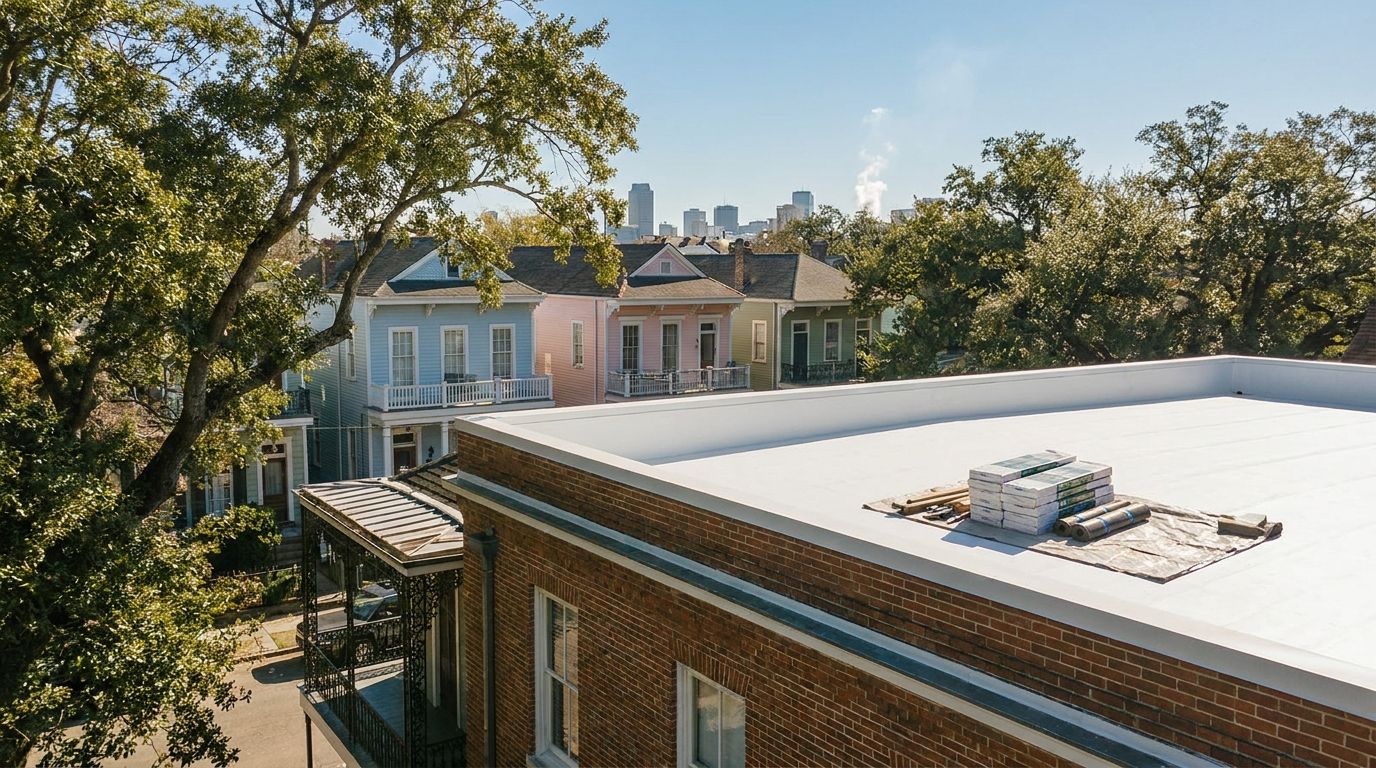
Commercial Flat Roof Replacement in Uptown New Orleans: A Case Study
By Clear Home Team · May 22, 2026
The building and the problem
A few years back we got a call from the property manager of a mixed-use building on Magazine Street in Uptown New Orleans. The three-story structure houses retail on the ground floor and offices above. The existing flat roof was original EPDM installed in the late 1990s. It had started leaking again after Hurricane Ida, and the owners were tired of patching it every storm season.
We walked the roof with the owner and the insurance adjuster the same week. What we saw was typical for older flat roofs along the Louisiana coast. The membrane had alligator cracking in several places, seams were pulling apart, and ponding water sat in low spots where the deck had settled over time. Interior water stains matched up with those problem areas.
The building sits just blocks from the Mississippi River. That means it catches every bit of wind-driven rain our Gulf hurricanes throw at it. Salt air and intense UV don’t help either. EPDM can last a long time in milder climates, but here it had simply reached the end of its service life.
Why the old roof kept failing
Flat roofs in Greater New Orleans face challenges most inland contractors never see. Hurricane-force winds try to peel the membrane at the edges. Heavy rains test every seam and penetration. Our humid summers keep the deck wet once a leak starts, which leads to rot in the wood framing underneath.
In this case the original installation used mechanical fasteners that had worked loose over twenty-plus years. The insulation below had compressed and lost its R-value. We also found several roof penetrations for HVAC and plumbing that had never been properly flashed for our weather.
Ponding water was the biggest red flag. Even after small storms, water sat for days in places where the roof had sagged. Standing water breaks down almost any membrane eventually. The owner showed us repair invoices going back to Hurricane Katrina. Each time they patched, the next big storm opened new seams.
Our assessment and recommendation
After a full inspection we sat down with the property manager and owner. We explained that another patch job would only buy them a couple more years at best. The decking in a few areas was soft, and the insulation was compromised. We recommended a complete removal and replacement with a modern TPO system.
TPO offers several advantages for commercial buildings in our region. The white reflective surface cuts down on heat gain, which matters when your AC units sit on the roof. Heat-welded seams create a monolithic sheet that resists wind uplift better than older glued systems. And the material holds up against our intense UV exposure.
We walked them through the insurance claim process step by step. Many commercial property owners don’t realize their policy may cover storm-related roof damage even if the roof is older. We helped document the hail and wind impacts from recent storms and prepared a detailed scope of work the adjuster could follow.
The carrier agreed the roof qualified for replacement. That took a big financial burden off the owner and let us focus on doing the job right instead of trying to stretch another few years out of failing material.
How we approached the replacement
We scheduled the work during a dry stretch in late fall, which is about as good as it gets for roof work in New Orleans. Our crew showed up with a full dumpster, safety rails, and tarps to protect the interior spaces below. Because this was a commercial building in a busy Uptown corridor, we also coordinated with the property manager to keep foot traffic moving safely on the sidewalk.
First step was careful removal of the old EPDM, insulation, and fasteners. We inspected every inch of the wood deck as we went. Any soft spots got replaced with new plywood before we moved forward. This is the part a lot of contractors rush through, but we won’t put new roofing over questionable decking.
We installed new polyiso insulation tapered to improve drainage. Getting water off the roof quickly is critical in our climate. The new TPO membrane went down in one large sheet where possible, with heat-welded seams that create a single continuous surface. We paid special attention to all the penetrations, installing proper metal flashings and counter-flashings sealed with lightning rods of sealant.
The edge details got reinforced with heavy-duty coping and termination bars. On a building this tall, wind uplift is a real concern. We used fasteners rated for our wind zone and followed manufacturer specs exactly.
What the new roof looks like years later
That replacement was completed three years ago. We’ve been back twice for routine maintenance inspections. The TPO still looks tight. The seams are intact, and the reflective surface is doing its job keeping the building cooler. Most important, the owner reports zero leaks even after several named storms since installation.
The property manager told us their HVAC units are running more efficiently thanks to the cooler roof surface. Insurance renewals have been smoother too, now that they have a documented new roof with photos and warranties on file.
We left them with a maintenance plan that includes twice-yearly inspections. In our experience, catching small issues early keeps a commercial roof performing for its full expected life. That usually means twenty to thirty years with a quality TPO system when installed correctly.
Lessons for other commercial property owners
If you manage or own a building with a flat roof in the Greater New Orleans area, a few things stand out from this project.
- Older EPDM roofs from the 90s are reaching the end of their practical life in our climate.
- Ponding water and failed seams are signs it’s time to replace rather than repair.
- Insurance may cover the work if you can document storm damage. Don’t assume it won’t.
- Proper tapered insulation and drainage details prevent most future problems.
- Working with a local contractor who understands Louisiana wind zones and insurance requirements saves headaches.
We’ve replaced flat roofs on schools, offices, retail spaces, and warehouses from the North Shore to the West Bank. Every building teaches us something new about how our weather attacks different roof systems.
The key is matching the right material and installation methods to our specific conditions. What works in Chicago or Dallas often needs adjustment here along the Gulf Coast.
When to call for a commercial roof inspection
Don’t wait for water stains on the ceiling. If your building has a flat roof more than fifteen years old, schedule a look before the next hurricane season. We can spot issues from the ground in many cases, then confirm with a full roof walk.
Our process is straightforward. We document everything with photos, prepare a clear scope of repair or replacement, and help you understand your options. Whether it’s covered by insurance or a straight cash project, you’ll get the same crew from start to finish and a written warranty you can count on.
Commercial roofing is different from residential work. The scale is bigger, the consequences of failure are higher, and the details matter more. We’ve been handling these jobs across South Louisiana for over twenty years.
If you’re responsible for a commercial building in Uptown, Downtown, Metairie, Kenner, or anywhere on the North Shore or West Bank, give us a call. We’ll walk the roof, tell you honestly what we see, and give you a written estimate within twenty-four hours.
There’s no obligation, and you’ll know exactly where you stand before making any decisions.
Keep reading
Ready to talk through your roof?
Licensed Louisiana roofing contractor. Free assessments. No high-pressure sales.